
Blog

Ask for a Coverage Map, Not 30 cm on the Slide

Walk a coverage map on your steel aisles, pick bay-level or zone-level where it pays, and stop buying lab centimeters for a brownfield floor.

  • Patrik Pasko

  • September 21, 2026

twinzo logistics analytics on a phone
Ask for a Coverage Map, Not 30 cm on the Slide

A Meter of Error Puts the Tag in the Next Aisle

UWB can report 30 cm in a lab. On a loaded warehouse aisle that number is often irrelevant. Conventional selective pallet racking leaves about three to three and a half meters between faces for a counterbalance truck. Very narrow aisle layouts go toward two meters. A ranging error of one to two meters is enough to place the live pin in the neighboring aisle, or inside the rack steel.

That is a process failure, not a rounding error. WMS already knows the bay (12-B-04). The driver can see the face. If the RTLS map disagrees about which aisle the truck is in, people go back to radio. The system you bought to remove that chain becomes another conflicting source.

Design for the brownfield hall: metal racks, mezzanines, and trucks parked where the load or the charger is. Fit-for-purpose accuracy on that floor is the requirement. Lab centimeters are not.

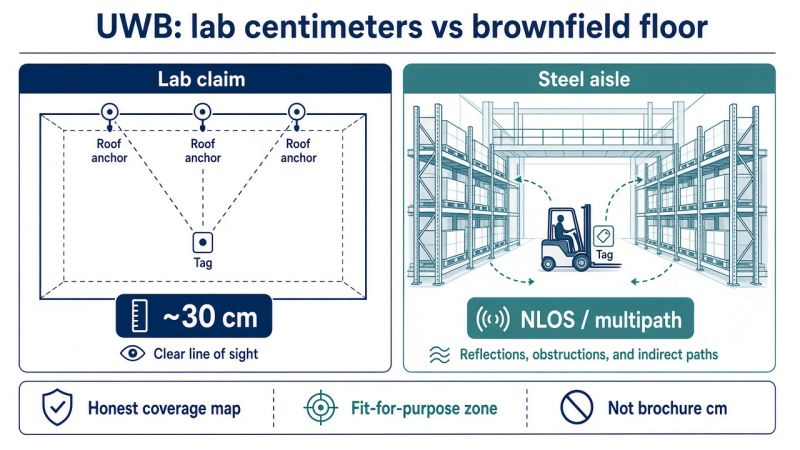
UWB lab claim of about 30 cm with clear line of sight versus NLOS and multipath in a steel warehouse aisle

Lab Line of Sight Is Not Your Floor

Vendor slides show an empty box, roof anchors, and a tag with clear line of sight. In that geometry, ultra-wideband two-way ranging can be sharp. The first arriving path is the direct path. Time of flight maps to distance. The error bar stays tight because nothing blocks or reflects the pulse.

A warehouse is the opposite geometry. Pallet racking is a steel grid with loads at every level. Mezzanines add a metal plane over the travel lane. Dock doors, mesh cages, and the forklift body sit in the RF path. Trucks park under mezzanines at charge points and in the last free slot between double-deep racks. Those locations are operational, not RF-friendly.

The lab figure is valid physics for an empty LOS site. It is not a measurement of your hall. An empty demo, a trade-show booth, or a vendor lab does not tell you how the tag behaves between loaded rack faces, with other trucks parked under the same anchors.

NLOS and Multipath Stretch the Error Bar

Non-line-of-sight (NLOS) means the direct path is blocked. Multipath means the pulse also arrives after bouncing off rack faces, the mast, a mezzanine deck, or a parked truck. UWB engines try to lock onto the first arriving path. When that path is weak or missing, they lock onto a later reflection. The reported range still looks plausible. The position is meters off, not centimeters.

Coverage measured in an empty travel lane at mid-shift will not match coverage at shift change, when several trucks sit under the mezzanine at the charge cluster. Tags then sit behind steel decks and next to other metal bodies. The install did not fail. The fleet used the parking the plant actually has.

Wi-Fi site surveys already assume this. Access points are not certified from an empty lab plot. Hostile corners are walked with inventory in place. RTLS needs the same survey, especially in brownfield halls where the steel predates the anchors.

Bay-Level, Aisle-Level, and Zone-Level Are Different Jobs

Accuracy is a job spec, not a single plant-wide number. A cycle count or pick confirmation that must match a bin (12-B-04) is bay-level. Forklift spaghetti, congestion, empty rides, and 'which hall is the borrowed truck in' are aisle or zone jobs. One sentence that says 'we need 30 cm everywhere' overbuys UWB and still fails in the worst aisle.

Static stock already has bin IDs in WMS. You do not need centimeter radio for every SKU. For that class of goods, live 3D stock from ERP without RTLS is the cheaper source: the pin comes from the system that already owns the bay. Spend radio budget on moving assets WMS does not see: trucks, tuggers, and cages.

Logistics optimization fails when you cannot see which aisle ate the shift, which buffer is blocked, or which loop is empty travel. Those questions work at zone level. Bay-level anchors pay only where a wrong aisle stops a pick or a safety rule. Write that split before anyone fills the roof.

False No-Go Alerts Kill the Safety Rule

Plants paint pedestrian lanes and fire routes because industrial truck and pedestrian collisions are a known high-risk pattern. Those lanes then become no-go areas on the twin, with a notification on tagged entry. The rule only works if the pin is in the lane when the truck is in the lane.

If a reflected tag clips the walkway by a meter, the alert fires while the truck is still in the travel aisle. Operators acknowledge, then mute. A later real entry into the fire route gets no response. Trust is the control. Bounce destroys it. Brochure centimeters do not mention this failure mode.

Fit-for-purpose options: a wider no-go polygon, a dwell threshold before alert, denser coverage only on that corridor, or no bay-level safety claim in a steel pocket you have not mapped. Internal logistics optimization on the twin is useful when no-go, spaghetti, and congestion share one hall picture the floor still believes after week two.

The Proof Is a Coverage Map on Your Layout

Required proof is a coverage map on your floor, not a slide. Measure with inventory in the racks, a tag on a real truck, in the aisle that already causes radio trouble. The map must show where error stays inside an aisle, where the pin jumps a bay, and where position is unusable. Brochure centimeters do not belong on that drawing.

Mount the tag where operations will keep it: cage, cabin roof, or mast guard. Do not survey at chest height in the aisle centerline. Repeat with another truck in the worst parking slot. Repeat under the mezzanine at shift end. If the vendor cannot produce that map, you have a lab number, not a plant number.

Put the map on the same hall model operators use. A coverage hole should sit next to the pick face, not in a vendor PDF. The twinzo features stack is built around that shared floor, not around one radio claiming the whole building.

How to Run a Fit-for-Purpose Trial

Name the job before you name the technology. Measure only what that job needs.

1. Write the decision the pin must support - bay pick, aisle presence, hall occupancy, or no-go entry. If two jobs disagree, they are two zones, not one accuracy target.

2. Pick the hostile pocket - loaded selective racks, mezzanine travel, dock with cycling doors, charging cluster. Do not certify the empty receiving hall and extrapolate.

3. Mount the tag as operations will live with it - same height, same nearby metal, same parking habit. Hand-held surveys do not represent forklifts.

4. Score aisle versus bay, not average centimeters - count how often the pin leaves the true aisle on a real loop. An average of 40 cm with aisle jumps fails picks and can still pass spaghetti analysis.

5. Draw fit-for-purpose zones on the twin - dense UWB only where the job needs it. Zone-level elsewhere. Record the coverage map against those zones.

For technology choice, use getting started with RTLS. twinzo can combine several location technologies in one building. The trial decides which pocket gets which stack. The sharpest brochure should not win the whole roof.

One Hall Can Mix Precision

Brownfield plants almost never need one radio from gate to last rack. Receiving can have decent line of sight. High-bay is a steel canyon. A production buffer can be a mixed pedestrian zone where a wrong aisle is a safety problem. Installing UWB on all three because the high-bay is hard puts capex on square meters that would work with BLE or with WMS pins.

On the twin, mixed precision is a layout decision. Zone-level BLE on the forklift loop still draws spaghetti and area occurrence. UWB on a cage that must not enter a press cell. Bin coordinates for static stock. Outdoor GPS until the gate, indoor from there. Operators see one object. Infrastructure behind it can differ by pocket.

A first install does not need a full UWB grid. The DIY forklift optimization tutorial is a BLE starter on about a thousand square meters, aimed at 'which truck is in which hall' and empty travel, not slot-face precision. Use that class of install where the coverage map says zone is enough. Keep the dense grid for pockets that fail the aisle test.

Aisle-Level Pins Still Feed Logistics Analytics

If the pin is trusted inside an aisle or a zone, the same analytics as live tracking apply. Area occurrence shows which buffers and intersections consumed the shift. Dwell shows docks that look free on a whiteboard and are blocked on the map. Congestion shows corners where trucks idle, including charge clusters the coverage map already flagged.

That is where plants usually recover cost. Internal logistics is often the last function measured, so empty travel, search time, and uneven saturation stay in radio chatter. Logistics analysis on the digital twin starts with spaghetti and saturation for that reason. You do not need 30 cm to see half the fleet looping one intersection while another hall starves.

Path playback still works at zone level. The line is coarse and still enough to change a route, redraw a no-go, or cut a truck. Extra centimeters for a thinner spaghetti plot do not change the decision.

ROI Is Trusted Position, Not a 30 cm Line

The business case is not 'we achieved 30 cm.' It is minutes not spent searching aisles, fewer empty rides, fewer muted safety alerts, and docks that match physical occupancy. Those outcomes work at zone level. They fail when the map disagrees with the driver and the floor returns to radio. That is the ROI to defend, not a lab centimeter line.

UWB everywhere has costs lab slides omit: powered roof anchors, more expensive tags, and a new survey after the next racking change. If bay-level is required on two aisles and zone-level is enough elsewhere, the honest ROI is a mixed install. twinzo pricing is easier to defend when radio spend follows the coverage map instead of one accuracy line on the CAPEX sheet.

Use the map in the finance meeting. Green: aisle presence proven. Amber: pin jumps under load. Red: do not claim a safety rule. The purchase is the set of zones, not the centimeter footnote.

Same Rule on Adjacent Jobs

Match accuracy to the job wherever a tag meets steel:

AGV docking versus forklift loops - station-face docking needs tighter local sensing. Hall occupancy for a manned truck does not inherit that spec.

• Tool crib and fixture cages - zone-level stops a long search. Bay-level only if two identical cages on adjacent faces can stop the line.

• Pedestrian mustering - people in the correct zone after the alarm, not 30 cm in a steel stairwell.

WIP with an existing board pin - radio does not fix a lying board. If the board is honest, a zone on the twin may be enough until the cage moves.

• Dock occupancy with cycling doors - metal doors are moving reflectors. Measure occupancy as a zone with the door open and closed, not as a centimeter claim from an open-door demo.

Ask Where 30 cm Was Measured

When a slide says 30 cm, ask which aisle it was measured in, on which truck, under which mezzanine, with racks loaded. Then decide pocket by pocket: bay-level, or aisle and zone. Fit-for-purpose is a pin the floor does not argue with, and alerts that still get read when finance asks what the money bought.

Get in touch if you want to walk a coverage map on your own facility model and mark the zones that actually need centimeters.

You might also be interested in:

No previous posts
Back to all posts
Agent-Driven Factory: Space Context, Then Logistics Commands

Agent-Driven Factory: Space Context, Then Logistics Commands

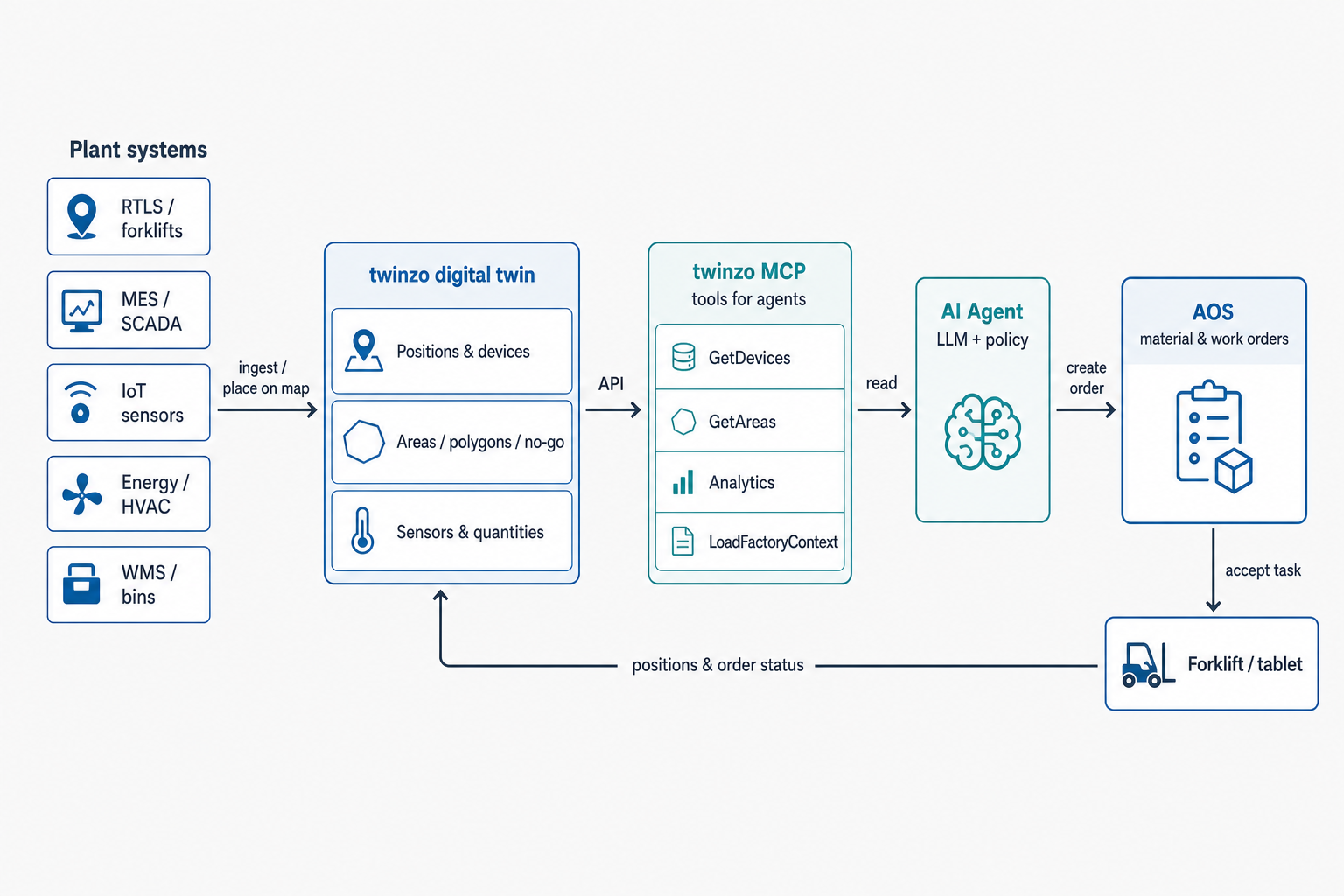
twinzo places independent plant systems on one spatial model. MCP exposes that model to AI agents. Agents read positions, areas, and analytics, then issue logistics activity commands the floor already accepts.

Landscape mode is not supported, please rotate your device.

By clicking “Accept”, you agree to the storing of cookies on your device to enhance site navigation, analyze site usage, and assist in our marketing efforts. View our Privacy Policy for more information.