Blog

Hardware Is the Small Part. The Building Sets the Bill

Price the ceiling work with the hardware, then buy only the anchor grid your real mounts can still cover.

  • Patrik Pasko

  • September 29, 2026

twinzo logistics analytics on a phone
Hardware Is the Small Part. The Building Sets the Bill

Saturday Night Under the Crane Rail

The logistics lead signed a clean RTLS quote on Friday: price per anchor, price per tag, accuracy on the datasheet. Saturday night the install crew is still in the hall with a rented scissor lift, production stopped for the window, and the crane rail that owns the main aisle still forbids a mount exactly where the drawing put three nodes. Facilities will not hang anything that blocks travel or sits inside a sprinkler keep-out. The electrician is waiting on a tray route that was full in 2014.

‍

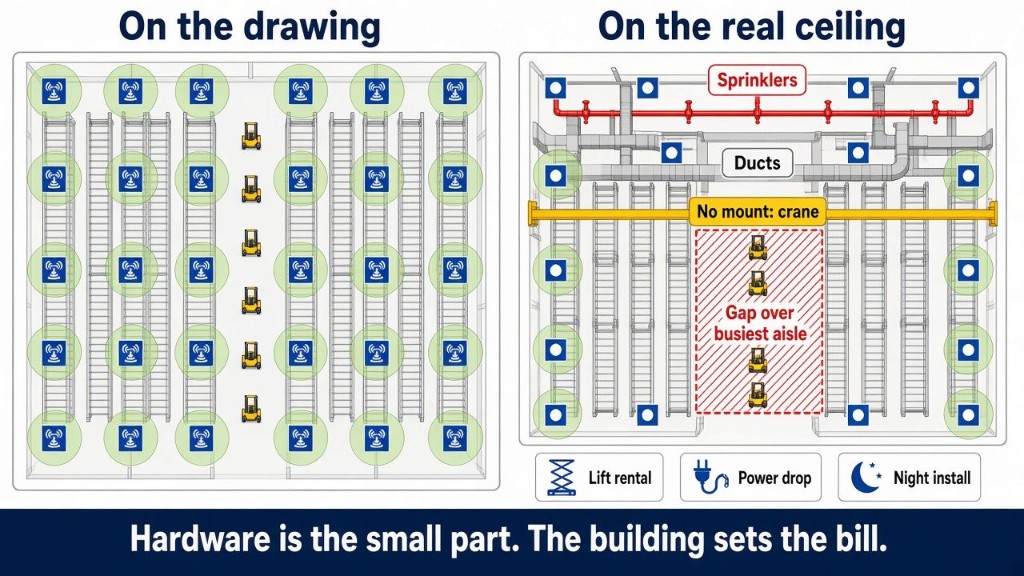
That is the old-plant pattern. Hardware is the small part of the bill. The building sets where anchors can go, and where they go decides coverage. The drawing showed even spacing and a green carpet over every aisle. The real ceiling leaves a gap over the busiest forklift lane because a crane runs there. Until that walk happens, comparing vendors on unit price alone is comparing the wrong number.

‍

On the drawing, RTLS anchors in a clean grid with full coverage. On the real ceiling, sprinklers, ducts, and a crane rail push anchors aside and leave a gap over the busiest aisle.

Quotes Compare Hardware. Plants Pay the Ceiling

Procurement sheets are built for SKUs. Anchors, tags, gateways, and a licence line stack neatly. That is how two vendors get ranked in a meeting. Brownfield halls do not score that way. The same UWB box costs different money in a new empty shell and in a 1980s high bay with crane rails and a full cable tray. Industry practice already treats work-at-height, electrical drops, and after-hours labour as first-class project cost on any ceiling network. RTLS is that class of work wearing a radio brochure.

‍

Put the install lines next to the hardware before you trust payback. Lift rental, night premiums, electrician hours, and remount contingency belong on the same sheet as tags. The checklist in what to include when calculating RTLS ROI exists for that reason. Total cost of ownership is not a finance slogan here. It is whether the live map still covers the aisle you bought the system to see.

‍

Lift Rental on Nights Because Production Cannot Stop

Mounting at height in a running plant almost never happens on day shift over a live travel aisle. Safety and output both push the work into nights and weekends. That means a scissor or boom rental for the window, a crew cleared for work at height, and often a second visit when the first mounts fail inspection or clash with a crane path. Sparse halls finish faster. Dense grids for continuous paths stretch the same crew across weeks of premium time.

‍

A typical moment looks like this. The lift sits under bay 14 while the night shift waits for the lockout on the aisle. One anchor takes a few minutes of fastening once the basket is in place. Getting the basket there, waiting on traffic, and moving to the next forbidden zone eats the hour. Multiply that by every node that cannot use the 'ideal' grid point. The rental invoice grows while the hardware still sits in boxes on the dock.

‍

Budget the windows early with production and facilities. If the plant only releases the hall two Saturdays a month, your go-live date is a facilities calendar, not a vendor slide.

‍

Power at Every Anchor Point, or a Long Cable Run

Many grids need hard power or PoE at each fixed node. A power drop in an old hall is not a plug on the drawing. It is tray space, a spare breaker or switch port, fire-compartment rules, and an electrician who shares the same night window as the lift. Plants that already own spare ports and clear tray routes absorb less. Plants that must open ceilings or cross fire zones add both cost and schedule risk before the first live position appears.

‍

PoE does not erase the line. It moves supply to a closet, then still asks for cable pulled at height. Battery reference points help only where the job tolerates sparse BLE-style coverage and accept battery service later. Dense UWB cells usually keep the powered-node bill. Skipping a drop by sliding the anchor three meters (about 10 ft) sideways is how the radio cell drifts off the aisle you cared about.

‍

Count planned powered nodes on the quote, then add contingency for mounts that move after the ceiling walk. Do not assume every grid point already has a spare outlet waiting.

‍

Crane Rails You Cannot Mount On or Block

Overhead cranes own steel for a reason. Facilities and safety will not let you hang anchors on the rail, foul the travel envelope, or put a fixture where a hook or trolley can hit it. In many halls the crane path sits exactly over the main logistics aisle, the place where forklift spaghetti and empty rides matter most for internal logistics optimization.

‍

When those mounts are forbidden, the vendor pushes nodes to the periphery. Coverage circles shrink or stop overlapping over the centerline. The map still looks busy at the edges. The busiest travel lane goes dark or jumps aisles. Operators learn the gap in a week: the pin dies under the crane, radio chatter returns, and the safety or congestion rule you wanted on that aisle never sticks.

‍

Mark no-mount crane zones on the twin before you freeze density. If the job is 'see trucks on that aisle,' and the crane owns the centerline, you need an approved alternate geometry or a coarser technology for that pocket, not a datasheet promise.

‍

Sprinklers, Ducts, and Trays Sit on the Ideal Point

Fire sprinkler mains, HVAC ducts, and cable trays occupy the roof plane that RF planners treat as empty. Clearance rules around sprinklers are not optional. Ducts create both a physical block and an RF shadow. Trays are already full of circuits that keep the line running. The 'perfect' five-by-five grid on the CAD plan lands on those conflicts more often than it lands on clean steel.

‍

Each forced move changes neighbor spacing. A few centimeters (inches) of slide rarely matters. A meter or two (3 to 7 ft) sideways, repeated across a bay, opens holes. Non-line-of-sight (NLOS) from rack steel then stacks on top of the geometric gap. The engine still reports positions. They are just not trustworthy where the trucks actually drive.

‍

Walk the ceiling with facilities and the vendor together. Photograph conflicts. Update the mount plan on the same hall model operators already recognize. A PDF grid that ignores the duct run is a lab drawing wearing a plant logo.

‍

High Bay: One Anchor Takes an Hour, Not Ten Minutes

Demo halls and low clearances hide the labour curve. In a high bay, every basket move is slower. Reach is longer. Wind and sway matter outdoors under canopies. Indoors, parked racks and parked trucks force detours. One fastener job that looked like ten minutes on a low mezzanine becomes an hour of positioning, waiting, and re-tries when the mount clashes with a tray or a sprinkler keep-out.

‍

That hour is not a training problem. It is geometry. Crews who install lighting and cameras already know it. RTLS inherits the same curve because the nodes live in the same air space. If your CAPEX sheet assumes warehouse-store install rates on a twenty-meter (~65 ft) clear height, the schedule and the night premiums will miss.

‍

Ask vendors for install hours on a site like yours, not on their lab. Then multiply by your real window calendar. Hardware unit price stays flat. Crew hours do not.

‍

Where Anchors Go Decides Coverage

Coverage is not a property of the radio alone. It is a property of the final mount plan under load. Move three anchors off the crane aisle and the green halos on the drawing stop overlapping where the forklifts run. The same plant can look 'fully covered' in a vendor heatmap drawn from ideal points and still fail the aisle test after install.

‍

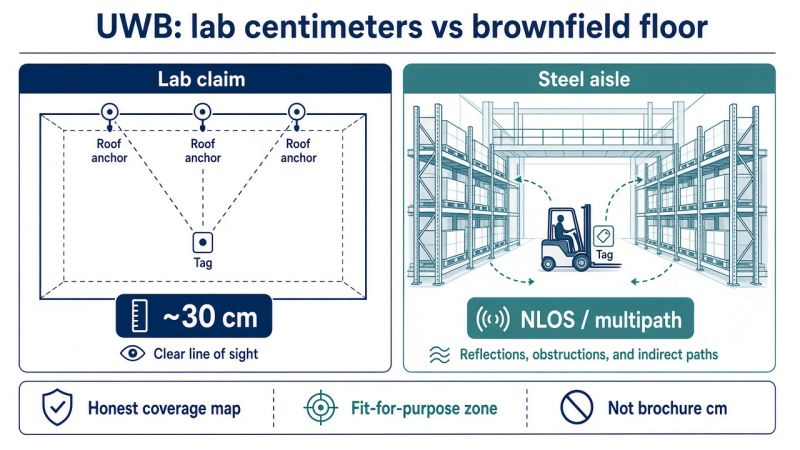
That is why a coverage map on your floor beats a datasheet centimeter (inch) line. Measure with inventory in the racks and a tag on a real truck, after the mounts you were actually allowed to hang. The companion argument for accuracy claims is in ask for a coverage map, not 30 cm (12 in) on the slide. Here the map has a second job: prove the building-constrained grid still supports the decision you bought RTLS for.

‍

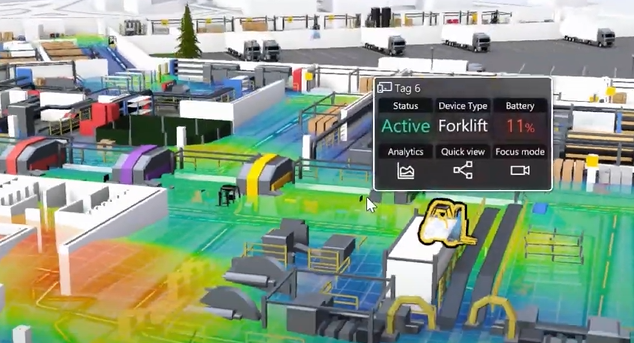
Put the gap on the twin next to the pick face or the main aisle, not in a kickoff deck. If the busiest lane is red, do not claim spaghetti, dwell, or no-go rules there until the geometry changes or the job is redefined to zone level.

‍

How to Price the Building Before You Buy the Grid

Name the aisle and the decision first. Then cost the ceiling that can support it.

‍

1. Write the floor decision - which aisle, buffer, or no-go rule must have a trusted pin. Use start with the decision, not the technology before anyone opens a hardware table.

2. Walk the ceiling with facilities - mark crane envelopes, sprinkler keep-outs, ducts, and full trays on the same layout as the twin.

3. Cost access - lift type, night or weekend windows, permits, and work-at-height crew for every planned mount height.

4. Cost power and backhaul - count power drops or PoE runs, spare switch ports, and closet capacity. Add cable metres (feet) through metal halls.

5. Re-draw the grid on allowed mounts only - then run or demand a coverage map on that geometry, not on the original CAD ideal.

6. Split density by pocket - dense radio only where the map and the job require it. Zone-level elsewhere, including options from getting started with RTLS when one building mixes technologies.

‍

If a vendor cannot price steps 3 to 5 against your hall, you have a hardware quote, not an install quote.

‍

Buy Fewer Anchors Where the Ceiling Will Not Cooperate

Brownfield plants almost never need one dense grid from gate to last rack. Receiving may have clean steel and spare power. The crane aisle may never accept an ideal mount. A production buffer may need tighter rules for safety while the long forklift loop only needs hall occupancy. Filling the whole roof because one pocket is hard is how install cost and coverage both go wrong.

‍

On the twin, mixed precision is a layout decision. Zone-level coverage still draws spaghetti and area occurrence for logistics analysis. Bay-level radio stays where a wrong aisle stops a pick or a muteable alert would kill trust. Static stock that already has bin IDs can stay on live 3D stock from ERP without RTLS instead of another powered node. Outdoor legs can stay on GPS until the gate. Operators still see one object.

‍

That split is also how you defend twinzo pricing and radio CAPEX in the same meeting: spend follows the building-constrained coverage map, not one accuracy line copied onto every square meter (ft²).

‍

Trusted Zones Still Feed Logistics Analytics

Once a pocket is green on the coverage map, the same analytics as live tracking apply. Area occurrence shows which buffers ate the shift. Dwell shows docks that look free on a whiteboard and are blocked on the map. Congestion shows corners where trucks idle, including charge clusters under steel. Logistics analysis on the digital twin recovers cost at aisle and zone level when the pin stays in the true lane.

‍

Do not wait for a perfect crane-aisle grid to start measuring empty travel in halls you can already mount. Run path playback where mounts are honest. Keep the red pocket off the safety rule until geometry or technology changes. The twinzo features stack is built around that shared floor picture, not around one radio claiming the whole building from a drawing.

‍

ROI is minutes not spent searching, fewer empty rides, and alerts people still read. Those outcomes fail when the busiest aisle was never coverable after the ceiling walk, no matter how cheap the anchor looked on the quote.

‍

Same Ceiling Bill on Adjacent Jobs

Mount constraints show up wherever fixed nodes meet an old roof:

‍

• Camera and RTLS sharing one lift window - pull both scopes into one night plan so you rent the lift once.

• Mezzanine travel lanes - steel decks block mounts and RF. Survey under load at shift end, not only at mid-shift empty.

• Dock canopies and cycling doors - outdoor-to-indoor transitions need power and weather-rated mounts the indoor quote omitted.

• Charge clusters under existing bus bars - clearances and tray congestion often forbid the 'ideal' gateway point above parked trucks.

• Racking refreshes after go-live - a new high-bay block can orphan mounts and force a resurvey. Treat anchors as plant infrastructure with an owner.

‍

Compare Install Sheets, Not Only Price Per Anchor

When two quotes look close on hardware, ask which one priced the lift nights, the power drops, the crane no-mount zones, and the coverage map after those constraints. The cheaper box that cannot hang over your main aisle is not cheaper. It is an incomplete bill and a hole in the twin.

‍

Get in touch if you want to walk your ceiling constraints on your own facility model and mark the pockets that still deserve dense anchors.

‍

You might also be interested in:

Ask About History, Not the Live RTLS Map

Ask About History, Not the Live RTLS Map

Dots on the live map look great in the demo. By mid-morning nobody is watching. Replay yesterday's late order and you see the crossing wait, the orphan pallet, and the empty trucks you can actually fix.

Ask for a Coverage Map, Not 30 cm (12 in) on the Slide

Ask for a Coverage Map, Not 30 cm (12 in) on the Slide

Vendors quote 30 cm (12 in) in an empty lab. On a steel aisle the tag jumps bays. Ask for a coverage map on your floor, then decide if you need bay-level accuracy or aisle and zone is enough.

Landscape mode is not supported, please rotate your device.

By clicking “Accept”, you agree to the storing of cookies on your device to enhance site navigation, analyze site usage, and assist in our marketing efforts. View our Privacy Policy for more information.