When RTLS helps, and when it does not
A real-time location system (RTLS) pays when tagged people, vehicles, or loads still move after the last scan. This page names the shift benefits, and the plants that should skip a location grid.
What the benefit actually is
The benefit is not a prettier map. It is the minutes between events other systems already own. A barcode at the dock is true at the scan. An ERP transfer is true when someone confirms. An MES complete is true at Station 4. None of those records move when the forklift takes a detour, parks in a buffer, or drops the cage one aisle over. That is asset tracking that has to stay true during the shift, not only at the next checkpoint. The indoor layer vendors call an indoor positioning system is the same job when the output has to drive a live decision, not a one-off survey. The companion definition lives under what RTLS is.
Plants that already own warehouse software still lose those minutes. Automotive and white-goods halls hunt tuggers even when every pallet has an ID, because the ID is not a live pin. WIP cages drift. A driver radioed “on the way” can be waiting at a shared aisle. RTLS does not replace WMS, MES, or ERP. It fills the gap they leave so the map matches the hall.
GPS works in the yard. Under a steel roof it does not. Indoor location uses radios, gate readers, or the vehicle's own SLAM so the pin sits on a hall people already know. Buy that pin only if a supervisor will act on it this shift. Otherwise walking is still cheaper.

Benefits that show up on a shift
The first benefit is search time. Zone-level Bluetooth Low Energy (BLE) is enough to stop a five-minute walk when the question is which aisle holds that tugger. Supervisors send the driver to a bay instead of starting a hunt. The last meters stay on foot. Sparse coverage still pays in halls that already have pallet IDs, because the missing piece was never the barcode. It was the live place.
The second benefit is waste that last-scan never sees. Empty rounds, dwell in a blocked buffer, and spaghetti paths that exist because a shared aisle is a daily pinch point. Coverage dense enough to rebuild those paths turns into a heat map the logistics lead can act on this week, not after a clipboard gemba walk that is already stale. Fleet management follows: utilization becomes a number you can cut trucks against, not a gut feel at month end. A bottleneck that looks like a machine wait is often a location wait. Cycle time on Line 3 is not a station problem when the kit is ten meters from the wrong cell. That picture is what internal logistics optimization actually runs on.
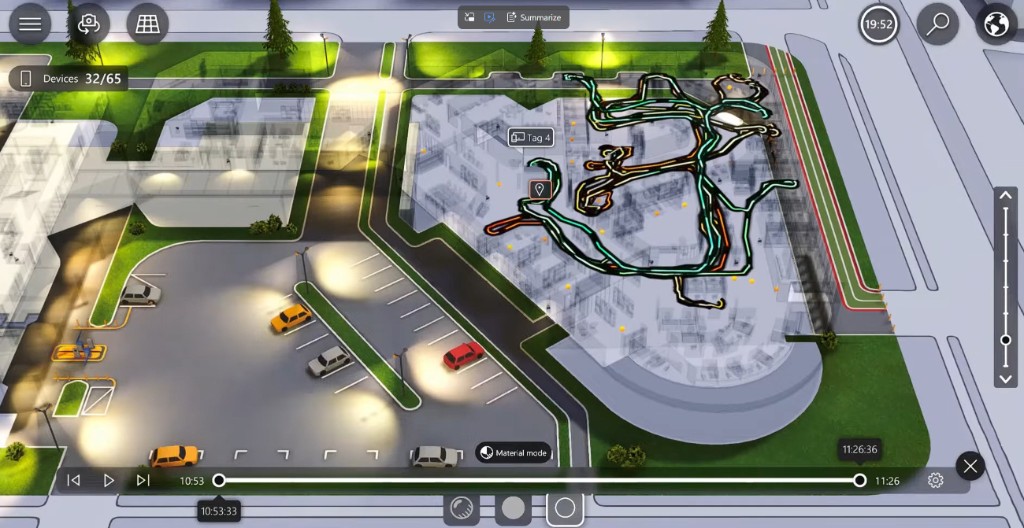
The third benefit is a rule the floor can enforce. A no-go zone, a geofence around a pedestrian box, a speed check on a corner that keeps producing near misses. Sub-meter ultra-wideband (UWB) starts to matter here. BLE that is honest at one to three meters will not certify a two-meter safety cell. RFID at a dock door is a different job: presence at a chokepoint, not a path through the hall. Match the radio to the decision, or the benefit never lands. The accuracy split is walked in more detail under starting with the decision, not the radio.
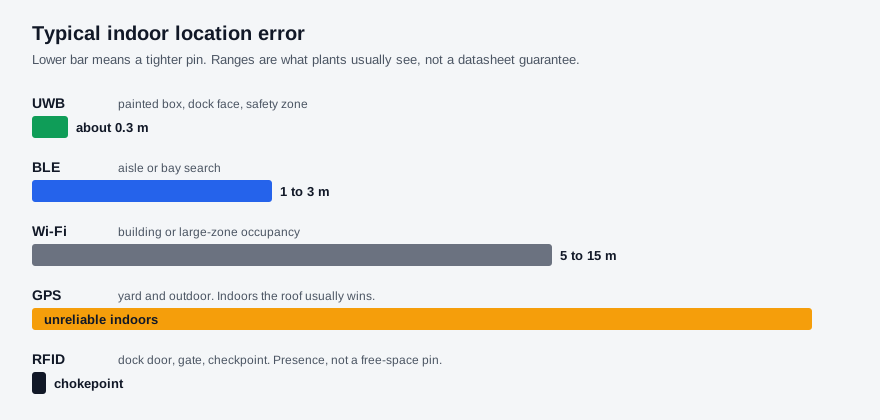
Once the pin sits next to production state, supervisors stop treating logistics as a radio channel. The same hall view that finds the cage also shows why Line 3 is waiting, which is the production monitoring job on a live digital twin. A longer radio primer lives in getting started with RTLS.
Who should skip a location grid
Skip the grid when the last scan is already the truth. A compact warehouse where every truck is in sight from the dispatch window does not have a location problem. Walking is cheaper than tags, anchors, and battery rounds. A plant that never moves a load without a scan, and that scan is the process, already has the record it will act on. RTLS will not fix a kanban that nobody pulls, or a just-in-time call that nobody answers. If the real fight is material call-offs, that is material order automation, not a ceiling full of locators.
Skip it when the job is stock on a map, not vehicles in motion. ERP locations can drive a live picture of inventory without tagging every pallet. That path is documented in live 3D stock from ERP without RTLS. Tagging every SKU for inventory management is a different economics problem, and it is how total cost of ownership quietly explodes.
Skip it when presence at a door is the whole question. RFID or a reader at the dock answers whether this load left. It will not draw the path, and you should not buy a hall-wide UWB grid to replace a gate. Yard-only work with a working GPS or GNSS feed is the same filter: do not install indoor anchors for a trailer park that already has sky.
Skip it when nobody will own the tags. Batteries, lost badges, and mounts that fall off a cage turn the map into last week's guess. Change management is part of the system. If the dispatch desk will not open the map during the shift, you bought a dashboard, not a location system. AGVs and AMRs that already localize with SLAM may not need a second radio layer for the same path. Computer vision at a buffer can answer a count without a tag on every cage.
A second-shift test the map has to survive
The typical moment is not the pilot walk at 10:00. It is 14:30, second shift, when the handover note still says the cage is inbound and Line 3 is waiting again. If the pin is wrong, or the tag is dead, the supervisor goes back to the radio. That is the test: does the live hall survive a shift change, a blocked dock, and a driver who parked where the WMS never wrote.
Multi-site search is the same test at a larger scale. A spare tool or a stillage that “must be at the other plant” still produces a phone chain when location is a last-scan record in a data silo. IoT and IIoT sensors that report state without a place still leave the hunt intact. State without a pin is not a location system.
How teams decide this quarter
1. Name the question this quarter will enforce - If the fight is which aisle holds the last pallet of that SKU, zone-level BLE or a sparse tag plan is the honest start. If the fight is whether that truck entered the pedestrian box, the zone geometry itself sets the radio. Do not buy UWB for a search problem, and do not ask BLE to certify a two-meter safety cell.
2. Separate presence from path - Dock confirmation and cage hand-off often need RFID or a reader at a known point. Continuous forklift paths, empty-round analysis, and live search need a stream that updates while the vehicle moves. Mixing those two jobs into one hardware SKU is how plants overpay for gates they could have scanned, or under-instrument halls they expected to map.
3. Price the tag count, not the floor area - Hardware, licences, and battery rounds follow tagged assets. A 15,000 sqm warehouse with a short list of vehicles is a different bill than a 30,000 sqm hall that wants utilization on every truck. The documented range of those outlays sits in the smallest documented RTLS case. ROI shows up when someone will change dispatch with the pin. It does not show up from a map nobody opens.
4. Put the pin on a hall people already trust - Coordinates in a table still force a translation step. The operational picture logistics and production will actually use is a live digital twin, the same layer described under types of digital twins. If the map does not match the columns and doors on the floor, the project becomes another screen.
5. Name who owns batteries and lost tags - A cheap tag that dies every quarter quietly turns the map into last week's guess. Match update rate to the decision: search can ping slower than a safety zone. If that owner does not exist, skip the buy.
Once the pin sits on a live twin
This is where twinzo sits after the concept is clear. The product job is not a second location vendor. It is the live hall view that can ingest BLE, UWB, RFID, SLAM, or the systems you already run, then put those pins next to material state and production signals. Capability detail lives on the features overview. Buy a pin at the accuracy the next action needs, on a map the shift already understands, only if this quarter's question is a location question.
Get in touch if you want to walk the same location question on your own facility model.