When RTLS makes sense for people
Two names get every urgent call. Three others wait for radio scraps. By the third quarter the hot people are gone, and the board still shows the same open roles. That pattern is the people filter for a real-time location system (RTLS): buy continuous location on badges or phones when unbalanced load, security rules, costly mistakes, or lone workers in hazardous areas are expensive enough to change how the shop runs, not when a people map sounds modern.
What the people decision really is
People location fills the minutes between clock punches, MES station claims, and radio check-ins. Those systems record that someone started a job or answered a call. They do not show who walked the longest path, who sat in the same buffer for an hour, or who stepped into a restricted bay. That gap is asset tracking applied to people, with privacy and policy as hard constraints.
The definition of RTLS sits under what RTLS is. Material and packaging economics live under when RTLS makes sense for material. Forklift fleet economics live under when RTLS makes sense for forklifts. This page stays on crews: load distribution, healthy working conditions, security, human error cost, and lone-worker safety in hazardous areas.
When fair load distribution is the reason to buy
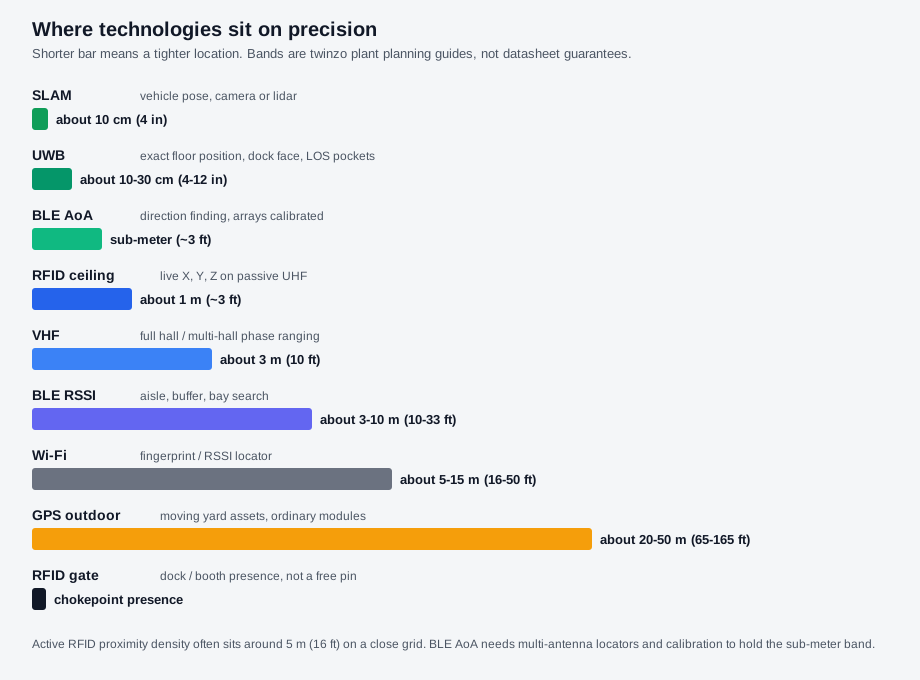
A healthy shop does not ask the same few people to absorb every surge. Supervisors need a shared picture of who carried travel, dwell, and peak calls across the shift, not a gut feel from who answered the radio fastest. Medium-precision location around 1–3 m (3–10 ft) is usually enough to see which corridors and cells owned the day. That evidence supports reassignment before overtime and fatigue harden into habit.
Efficient conditions follow the same map. When two technicians own every breakdown walk across a 15,000 m² (about 161,000 ft²) hall while others stay near the quiet cells, response looks fast for a week and then collapses. Balancing people load is the human twin of vehicle fleet saturation. How crews compare across shifts sits under shift balancing with RTLS and the shift balancing glossary term.
When unbalanced work drives labor turnover
High labor turnover is often treated as a pay or hiring problem. On many floors it is also an overwork problem. The people who leave are frequently the ones who carried the awkward nights, the longest walks, and the jobs nobody else wanted. Replacing them resets training cost and puts the same load on whoever remains.
RTLS does not explain every resignation. It does make workload concentration visible so HR and supervisors argue from the same hall picture. If the plant will not change rostering, lanes, or call rules from that picture, badges will not fix churn. If it will, keeping experienced people on a fairer load is often cheaper than another round of recruiting. That retention case belongs next to overall labor effectiveness and other labor KPIs, not instead of them.
When security and restricted access matter
Defense plants, proprietary process areas, and high-value labs need more than a locked door at the corridor. They need to know who entered a controlled bay, how long they stayed, and whether an escort rule held. Geofencing and no-go rules on people location turn those policies into alerts the shift can act on, not only a camera review after the fact.
Accuracy follows the decision. Coarse zone presence can answer which wing someone is in. Many no-go zones work at medium precision around 1–3 m (3–10 ft). Exact floor position in a tight cell often needs sub-meter (~3 ft) location so the alert matches the floor mark. Match the modality to that decision in start with the decision, not the technology. Location does not replace clearances, escorts, or visitor process. It closes the gap between badge-at-door and presence inside the room.
When human mistakes are costly
Same filter as material: if the miss is cheap, walking and radio may be enough. If the wrong person in the wrong place, a missed muster, or an unlogged entry into a controlled area costs real money, liability, or customer trust, continuous people location can pay. The expensive failure is 'we thought they were at Cell B' or 'nobody saw who crossed the line.'
Mustering after an alarm, proving who was near an incident, and keeping untrained staff out of a live cell are people problems with location answers. They sit beside production response on a live digital twin used for production monitoring. Do not buy people RTLS to decorate headcount dashboards. Buy it when a wrong presence or an unbalanced crew changes money, safety, or security outcomes.
Bonus: lone workers in dangerous areas
The same badge layer can cover a lone worker in a hazardous or remote zone: night utility rounds, confined bays after shutdown, chemical or high-voltage rooms, yard walks when the hall is empty. Radio check-ins help only while the person can still answer. Location plus man-down or SOS turns 'someone is hurt somewhere' into a bay the response team can reach.
Treat this as a safety bonus on a people program you already justify with load, security, or costly mistakes, or as a primary buy where lone work in dangerous areas is the plant's real exposure. Coverage must be honest in those rooms. A dead zone under steel or in a basement is not a lone-worker system. Keep the purpose written as protection, not scorekeeping, so the crew trusts the alert path.
Different mixes, different ROI
A high-turnover logistics crew with visible load skew is one case: badge the movers, rebalance lanes, measure again. A defense hall with strict zone rules and low churn is another: prioritize geofence accuracy and audit trails over utilization charts. A site with lone technicians in hazardous rooms may lead with distress alerts and area presence, then add load views later. A plant with cheap mistakes and a small visible crew may skip people tags entirely and keep supervisors on the floor.
Mixing every use into one hardware buy is how total cost of ownership and trust both fail. Name the primary job (fair load, security, costly error, or lone-worker safety), write the privacy and safety policy first, then size badges and update rate to that job. What to include in the cost model sits under what to include when calculating RTLS ROI. Capability depth once the case is clear sits on the features overview.
When you should skip
Skip when the crew is small, every person is in sight, and load disputes are rare. Skip when turnover is low and security is a door reader problem you already solved. Skip when leadership will use location as silent scorekeeping instead of fair distribution and safety. Skip when nobody will own badge charging, lost tags, and change management with the workforce. ROI does not show up from a people map nobody trusts.
Get in touch if you want to walk the same people mix (load, turnover, security, mistake cost, and lone-worker safety) on your own facility model.