When RTLS makes sense for material
A sequenced pallet leaves late, or the wrong cage rolls to the dock. The fine and the line stop arrive before anyone argues about maps. That cost is the material filter for a real-time location system (RTLS): buy continuous location on loads and packaging when a miss is expensive enough that knowing where the material is during the shift changes money, not when a nicer hall view sounds useful. People decisions sit under when RTLS makes sense for people. Forklift decisions sit under when RTLS makes sense for forklifts.
What the go or no-go decision really is
RTLS fills the minutes between events other systems already own. A barcode at the dock is true at the scan. A WMS putaway is true when someone confirms a bin. An MES complete is true at Station 4. An ERP transfer is true when stock moves on paper. None of those records follow a pallet, cage, or kit while it sits in the wrong buffer or rolls toward the wrong door.
That gap is asset tracking for material that has to stay true during the shift. The definition sits under what RTLS is. This page stays on pallets, cages, kits, and packaging. Use-case depth for those jobs sits under where RTLS benefits show up and the RTLS use-case articles. The question here is whether the plant's mix of WIP capital, delay impact, volume, and packaging is expensive enough that material location will change a decision this quarter.
When WIP capital makes location pay
High work in progress (WIP) is often a trust problem dressed as a shortage problem. When cages and kits drift after the last MES or WMS event, planners protect the line by releasing more material than the process needs. Capital sits on the floor. Congestion grows. A live location lets the plant cut safety stock that existed only because nobody trusted where the last batch was.
The ROI case is strongest when the material on the floor is valuable, sequenced, or hard to replace, not when every carton is cheap and interchangeable. If a missing kit can idle a cell for an hour, or if buffers already hold days of cost, knowing bay-level location around 1–3 m (3–10 ft) is usually enough to change release and dispatch. That WIP story deepens under production and logistics views such as production monitoring.
When late or wrong loads cost real money
Some plants pay in fines, chargebacks, or stopped customer lines when the wrong pallet ships or the right one ships late. Automotive and other sequenced feeds make that pain sharp: a just-in-sequence or just-in-time miss is not a tidy warehouse variance. It is a contractual and production event.
RTLS helps when the expensive failure is 'we thought it was at the dock' or 'we pulled the twin of the right cage.' Continuous location next to the shipment identity cuts those surprises. It does not replace ASN discipline or dock process. It closes the gap between the last scan and the trailer face so the plant stops gambling on radio memory. End-to-end visibility patterns for that class of flow sit under end-to-end JIT logistics visibility.
When delays have outsized impact
A five-minute search is cheap in a quiet spare-parts bay. The same five minutes on a bottleneck cell, a paint exit, or a dock window that closes with the trailer is expensive. Delay impact is the multiplier: how many people, machines, or customer commitments wait when one load is in the wrong place.
If Line 3 waiting costs more than walking Packaging twice a shift, location can pay even before anyone talks about fleet size. If the hall is small, every truck is visible from dispatch, and a miss only means a short walk, the same technology is a poor buy. Match the spend to the cost of delay, not to hall area alone. Radio and accuracy choice still follow the decision in start with the decision, not the technology.
Volume and packaging change the tag math
Volume decides whether a miss is a rare annoyance or a daily drain. Low move counts can absorb walks and radio hunts. High move counts turn the same friction into overtime, extra trucks, and chronic buffer bloat. The plant that moves hundreds of unit loads per shift has a different ROI shape than the plant that moves a handful of expensive tools.
Packaging decides what you can tag without exploding total cost of ownership. Returnable packaging such as racks, stillages, cages, and reusable totes amortizes a durable tag across many trips. Lost returnables are themselves a cost case. One-way packaging such as cartons is a poor host for expensive hardware. Those loads usually ride shipment labels and dock events, or a tagged pallet / vehicle, rather than a tag glued to every expendable wall. Mixing those models without a clear host is how tag counts and battery rounds quietly kill the project.
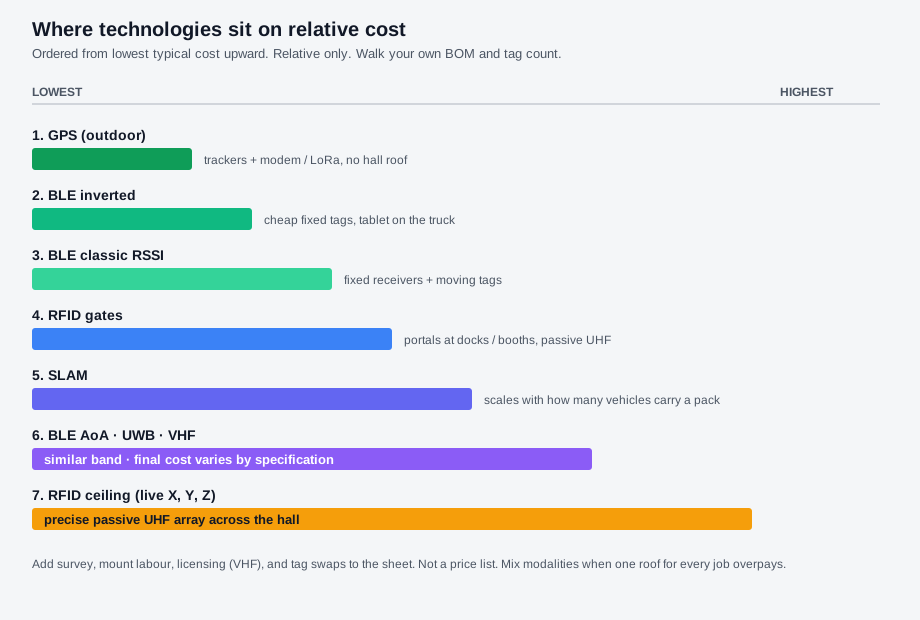
Different mixes, different benefits, different ROI
High WIP capital plus returnable cages on a sequenced line is one case: tag the returnables, cut buffer stock, protect sequence. High volume of cheap one-way cartons with low delay cost is another: often skip load-level RTLS and keep ERP or WMS truth, as in live 3D stock from ERP without RTLS. High fines for wrong outbound plus moderate volume may justify dock-face and staging location without tagging every SKU in the hall.
Fleet empty miles and driver load are real benefits too, but they are separate use cases with their own evidence under internal logistics optimization and articles such as pinpointing non-value-added travel. Do not force one ROI story onto every plant. Name the money at risk, the packaging host, and the volume, then pick the use case that matches. What to put in the cost model sits under what to include when calculating RTLS ROI.
When you should skip
Skip when the last scan is already the truth the process will act on, and a miss is cheap. Skip when delay impact is low, WIP is light, and volume does not punish walking. Skip tagging every one-way carton for continuous location. Skip a hall-wide grid when a dock gate answers the only question that costs money. Skip the buy when nobody will own tags, batteries, and the map during the shift. Change management is part of the system. ROI does not show up from a dashboard nobody opens.
If the real fight is material call-offs nobody answers, that is material order automation, not locators on the ceiling. Capability depth for the live hall once the economics say yes sits on the features overview.
Get in touch if you want to walk the same cost mix (WIP, delay risk, volume, and packaging) on your own facility model.