Exact floor position only where the mark matters
The fleet decision is which aisle the truck used. The quote prices every aisle as if the truck had to prove it was on a 20 cm (about 8 in) mark. The extra precision does not change the lease. It changes whether the investment pays back within six months.
Two decisions, two accuracy levels
Corridor, buffer, and fleet load usually need medium precision, about 1–3 m (3–10 ft). VHF planning at about 3 m (10 ft) sits in that same band for halls and yards. Exact floor position, often about 10–30 cm (4–12 in) with UWB where line of sight holds, matters when near the mark is not on the mark: a dock face, a tight cell, a confirmation that the vehicle is in the slot. Industry cost notes treat that step as a real jump in infrastructure per square metre (per square foot). Buying it for a whole hall prices the expensive band over decisions the cheaper band already settles.
How to tell those accuracy levels apart is described in zone presence vs medium-precision logistics track. The technology comparison is in compare RTLS technologies.
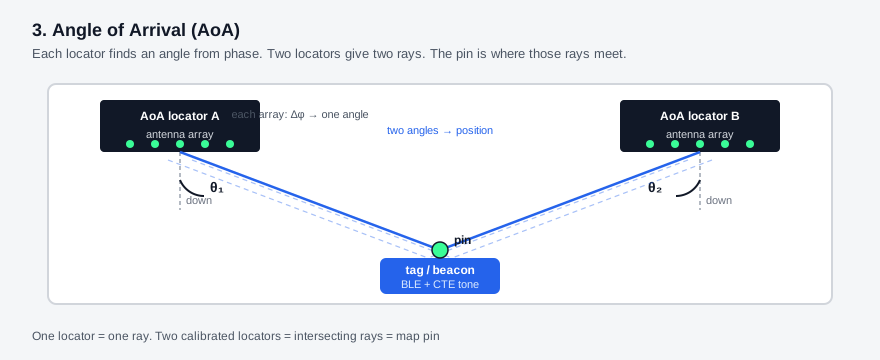
Where the tight zone earns its keep
Put UWB or angle-of-arrival on the mark, not on the building. A 100,000 m² (about 1.08 million ft²) roof and a small hall use the same rule. The large roof already has a shared medium-precision grid, described in one large building and a large fleet. The small hall stays on inverted BLE, described in small fleet in a small hall. The tight zone is a few bays in either place.
A documented 55,000 m² (about 592,000 ft²) white-goods plant invested €50,000 in logistics RTLS and brought average forklift speed from 15 km/h (about 9 mph) to 6 km/h (about 4 mph) while performance held. That result did not require a lab-grade grid across the whole roof. What that speed change meant is described in slower forklifts with the same performance.
How a lab-grade grid misses ROI within six months
A full-hall exact-position layout is how a large building fails to pay the investment back within six months. The anchors multiply with area, and the fleet decision never uses the extra centimetres (inches). A small exact-position zone can still pay back within six months, because its area is the mark, not the hall. How to judge that ROI is described in the six-month return depends on the combination.
Both accuracy levels can share one spatially oriented dataset. Correlation and causality analytics can then ask whether a miss on the mark, or an empty aisle, is what came before the stop. Live fleet work is part of internal logistics optimization.
How teams keep precision on the decision
1. Write the decision in metres (feet) before you name a technology - Aisle waste is about 1–3 m (3–10 ft). A mark is tighter.
2. Price the tight technology for the bays that need it - Leave the rest of the roof on the fleet combination.
3. Reject a hall-wide exact-position quote that cannot name the marks - Area times the dense band will not pay back within six months.
4. Keep the speed and fleet cases as evidence that medium precision already pays - Do not add centimetres (inches) to make a slide look stricter.
Capability depth is on the features overview. How a rollout is priced is on pricing.
Get in touch if a whole-hall exact-position quote is attached to a decision your supervisors already make at aisle scale.