Small fleet in a small hall
Eight forklifts share one compact hall. The quote that arrives is a dense locator layout copied from a site ten times larger. The trucks are not the problem. The quote is.
What a small hall can actually fund
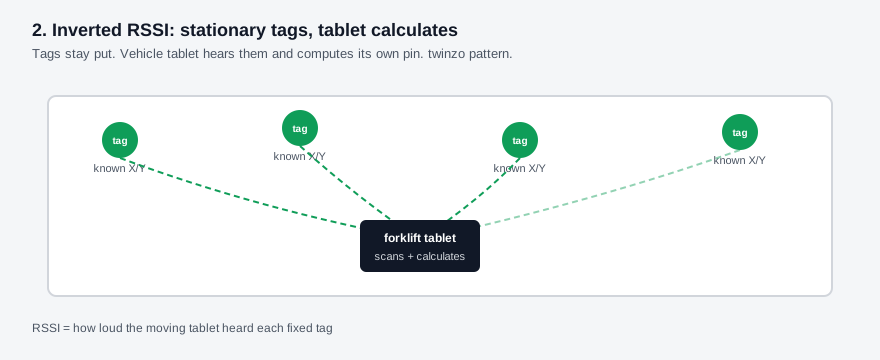
When both the hall and the forklift count are modest, the investment pays back within six months only if the hardware stays small. Inverted BLE puts inexpensive fixed beacons in the hall and a tablet on each truck, so the location travels with the fleet instead of a roof full of locators. If the waste you can count is phone calls and patrol, add AOS (commonly known as FGS) so the next job is a claimable work order.
A few classic BLE receivers can cover a compact footprint if you would rather tag the trucks. UWB, angle-of-arrival arrays, and ceiling RFID ask the small fleet to pay for a grid it will not fill. The empty travel can be real, and the investment still fails to pay back within six months, because the hardware is sized for a much larger fleet.
What a 15,000 m² warehouse already recorded
A documented 15,000 m² (about 161,000 ft²) logistics center invested €3,500 in logistics RTLS and recorded €11,000 of OPEX saved in the first year, with workload balanced across shifts in an L-shaped layout. AOS on a warehouse of the same size band invested €28,000 and recorded €65,000 of OPEX saved in year one after two command desks became one. Those figures already show a year-one saving larger than the investment, which is consistent with ROI within six months. They are not a licence to import a 100,000 m² (about 1.08 million ft²) anchor project.
The visibility story for that warehouse is described in what the smallest documented RTLS case actually looked like. How those two modules share one small site is described in small warehouse visibility and one command desk.
Where this combination stops
Inverted BLE still places beacons through the area the trucks must cover. A huge hall with the same eight trucks changes the cost, because the beacon count follows the roof. That case is described in small fleet in a large hall. A yard the trucks actually drive is described in indoor and outdoor on the same move. That is a VHF job, not a second copy of this hall.
Closed claims and positions still feed the spatially oriented dataset. Correlation and causality analytics can later ask which quiet corner of a small hall keeps preceding overtime. The dataset does not require a denser technology than the decision.
How teams keep the small-hall quote honest
1. Count trucks and measure the hall before you read a large-site quote - If both are small, start with inverted BLE.
2. Add AOS only when call and patrol minutes are the measured waste - That product is material order automation.
3. Leave UWB and ceiling RFID off this purchase - Revisit them only for a mark this hall must prove.
4. Check ROI within six months on this site's euros - The €3,500 and €28,000 cases are the template, not a 100,000 m² (about 1.08 million ft²) install. How that test works is described in the six-month return depends on the combination.
What the product can do is on the features overview. How a rollout is priced is on pricing.
Get in touch if you want to check whether your compact hall is being quoted a stack that belongs on a much larger roof.