The six-month return depends on the combination
A buyer copies the location stack from a 100,000 m² (about 1.08 million ft²) hall onto a small warehouse and wonders why the payback slides past half a year. The empty-travel problem was real in both places. The combination was not.
What ROI within six months is actually testing
Logistics ROI is only as strong as the RTLS combination on that site. Hall size, fleet size, and what must stay visible (trucks, yard, material) pick the technologies. A small hall and a 100,000 m² (about 1.08 million ft²) building can both pay the investment back within six months. An areal of different buildings across 2 km² (about 494 acres) can do the same. None of those sites earns that result by installing the neighbour's stack.
Industry cost guides make the same split. Infrastructure euros per square metre (per square foot) jump when the accuracy band tightens, and a hybrid of technologies usually beats one technology forced across every zone. twinzo treats that as a logistics decision in internal logistics optimization, with the bands compared in compare RTLS technologies.
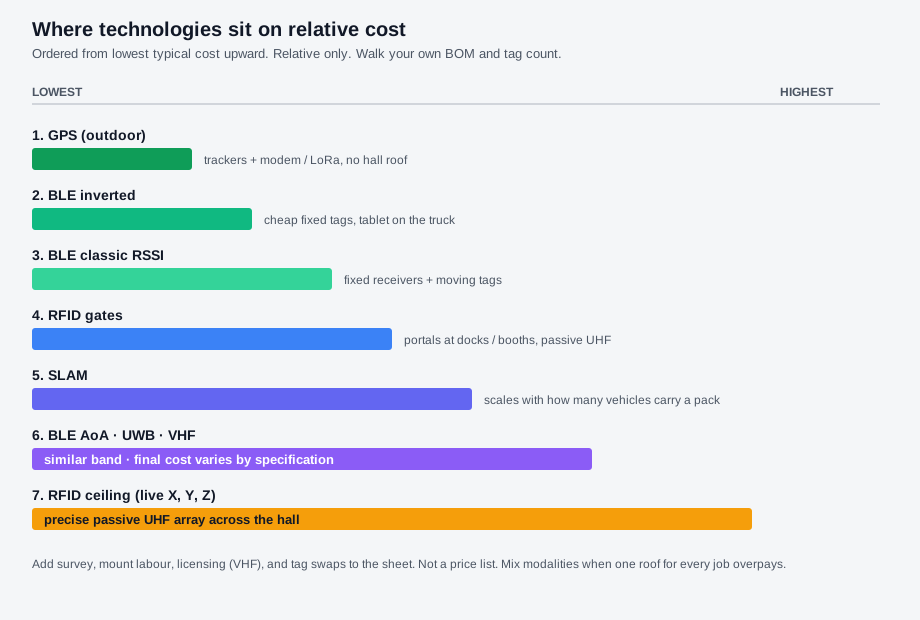
Why a copied stack misses ROI within six months
A dense anchor layout pays when many forklifts share one roof and the benefit is fleet operating cost you can actually cut. The same layout on a handful of trucks in a small hall spends the money on mounts that never see a second vehicle, so the investment does not pay back within six months. A pack on each truck does the opposite: it fits a small fleet in a large hall, and it gets expensive once every extra truck needs its own pack. VHF fits when the same asset must stay visible indoors and outdoors. A compact hall that never opens a yard door does not need it.
Documented sites already show the spread. A 15,000 m² (about 161,000 ft²) logistics center invested €3,500 in logistics RTLS and recorded €11,000 OPEX saved in year one. A 30,000 m² (about 323,000 ft²) automotive Tier-2 hall invested €120,000 and recorded €960,000 OPEX saved in year one after the fleet fell from 36 to 20 forklifts. In both cases the year-one saving is larger than the investment, which is consistent with ROI within six months. The amounts are not interchangeable.
What you still store after the payback
The combination that pays back within six months also fills a spatially oriented dataset. Live logistics uses it to find free capacity. Continuous improvement uses it after the sponsor of the project leaves. Correlation and causality analytics asks which empty corridors keep preceding a starve. Those three uses share the locations. They do not share a reason to buy the most expensive technology on the chart.
How teams pick a combination before they buy
1. Name the building, the fleet, and what must stay visible - Small hall, 100,000 m² (about 1.08 million ft²) roof, or 2 km² (about 494 acres) of different buildings.
2. Refuse the stack from the neighbouring site until this site's numbers fit - The pages that follow split those combinations.
3. Put year-one OPEX or recovered line time against the install for this combination only - ROI within six months fails when two modules' euros are added into one cell.
4. Keep a tighter technology for the few marks that need it - Medium precision, about 1–3 m (3–10 ft), covers most aisle and fleet decisions. Exact floor position is a smaller zone.
Costs that never appear on a tag price are listed in what to include when calculating RTLS ROI. What the product can do is on the features overview. How a rollout is priced is on pricing.
Get in touch if you want to test which combination pays back within six months on your own hall, not on the hall next door.