RFID for RTLS: gates, proximity, and live X, Y, Z
RFID (radio-frequency identification) is one identify-and-locate family with three location builds. Plants buy a gate, a proximity layout, or a live X, Y, Z position. Those are different vendors and different price points. The most advanced of the three is RFID RTLS: antennas mounted on the ceiling that track a live X, Y, and Z position while the tagged load still moves. This page covers what each build answers on the floor, and how to place all three on one hall map.
Gates confirm a crossing
Classic industrial RFID, especially passive UHF at dock doors, is a portal. Antennas frame a door, a paint booth, or a shipping lane. The reader fires a field. Tags in that field answer with an ID. The system records that this pallet, stillage, or cage passed this line at this time. The same pattern as a shop-exit gate: the gate knows the load went through. It does not know which aisle came next.
That answer is still the right buy for shipping confirmation, inbound receiving against a purchase order, booth exit, and cage hand-off between halls. A portal at dock 2 that fires into WMS or MES closes the event without a handheld scan when the field and tag placement are honest. Missed reads from metal, liquids, or overlapping portals are the usual failure mode. After the dock read, the cage can sit behind the wrong line for an hour while ERP and WMS still show the last confirmed location. The ID is strong at the choke point and stale everywhere else.
Proximity says which reader heard the tag
The second build stays in the RFID family and leaves the binary door behind. Active RFID, battery-assisted tags, forklift-mounted readers, and short-range exciter grids report that a tag is near a known reader, zone, or workstation. A long-range cell can say which hall or bay still holds the stillage. A dense exciter grid can hold about 5 m (16 ft) across an aisle, or bind a pallet to one station. The location comes from which antenna heard the tag, not from a free-space coordinate that updates as the asset walks the aisle.
Proximity is the honest buy when the question is “which buffer or station holds this returnable” and the plant already invests in RFID tags for identity. It is a different vendor stack and a different price point from a two-antenna dock portal. It is also a different product from ceiling RFID RTLS. Treat it as zone or station presence, then prove the read on your cages and stillages before you tag the fleet.
Ceiling antennas track a live X, Y, Z
The most advanced RFID build is RFID RTLS that tracks a live position. Antennas mount on the ceiling. They follow the tag through the hall and report X, Y, and Z while the asset is still moving: aisle, height on a rack, and the path between dock and line. That is a continuous location, the same class of job as other RTLS technologies, built on RFID tags and a ceiling array instead of a door or a proximity cell. Different vendors sell that ceiling array at their own price point. A portal quote and a ceiling-array quote are not the same project.
Many of those ceiling installs hold about one metre (~3 ft) on a maintained industrial aisle, tighter than a bay-sized proximity cell and enough for live search, dwell, and a path the shift can replay. The number to prove is the one on your racking, not a lab claim. Metal and overlapping fields still create ghost reads the middleware must filter. When the decision is a painted safety cell in tens of centimetres (under about 12 in), score UWB beside this RFID RTLS and buy the radio that holds the cell. Match the build to the question, the same rule as start with the decision, not the technology.
How teams pick among the three
1. Name the event you will enforce - Shipping door proof, booth exit, or cage hand-off is a gate. Bay or station search is proximity. Live search, empty-round paths, and rack height need ceiling antennas and a live X, Y, Z.
2. Price the vendor, not the letters RFID - Gates, proximity, and live position are different hardware, different integrators, and different price points. A cheap passive portal does not become a ceiling RTLS by adding more door antennas. Ask which of the three builds the quote actually installs.
3. Separate identity from path - RFID is strong when the tag already carries the SKU or carrier ID the WMS trusts. BLE and UWB often track the vehicle first. Many halls keep a gate or a ceiling RFID RTLS on the load and BLE on the forklift, then join both on one map.
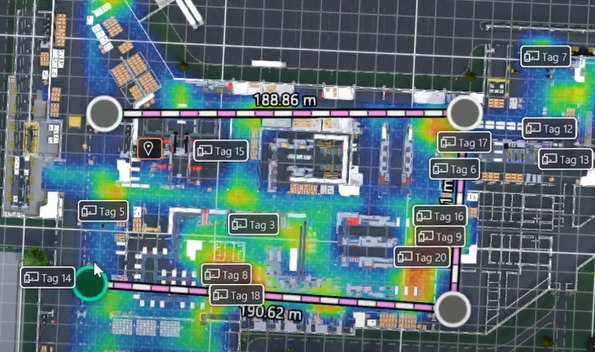
4. Put every event on one hall view - A dock timestamp in a table still forces a translation step. The picture logistics opens during the shift is a live digital twin where gate events, proximity zones, and live X, Y, Z positions share the columns and doors people already know.
Once RFID sits on the twin
This is where twinzo sits after the concept is clear. The product job is not another RFID vendor. It is the shared hall view that can ingest gate reads, proximity events, and ceiling-antenna X, Y, Z streams next to BLE, UWB, or SLAM locations, then feed the same picture into internal logistics optimization and production monitoring when a line waits on a kit that already cleared the dock. Capability depth lives on the features overview. For the BLE topologies that often sit beside RFID, see BLE for RTLS. Definitions start at what is RTLS.
Lock the build first: a gate, proximity, or live X, Y, Z from ceiling antennas. Buy the vendor and the price point that match that job. Then let the twin carry all three onto one map the shift already trusts.
Get in touch if you want to walk the same three RFID builds on your own facility model.