BLE for RTLS: three ways to get a floor location
Bluetooth Low Energy (BLE) is a low-power 2.4 GHz radio plants use to place tags, phones, and tablets on an indoor map. Plants use it for aisle or bay search, presence in a hall, path replay, and the first layer of live asset tracking before they buy denser radios. This page covers three ways to compute that pin: classic RSSI with fixed receivers, inverted RSSI with stationary tags and a mobile calculator, and Angle of Arrival (AoA).
What BLE is good for on the floor
BLE is the usual indoor starting point for medium-precision RTLS. Tags are cheap, batteries last years at honest advertising rates, and phones or tablets already speak the radio. Accuracy typically lands in the one-to-three-metre (3–10 ft) band when metal and coverage are honest. That band is enough when the shift question is “which aisle holds the free truck” or “which buffer still has the cage,” not “is the mast tip inside a painted half-metre (~1.5 ft) box.”
The radio family is not one product. Inside BLE, the topology and the measurement decide whether you hang locators on the building, put the calculator on the forklift, or upgrade to direction-finding arrays. Those choices change hardware spend, tag count, and how hard the install fights steel. For the wider technology menu, see RTLS technologies out there. For matching accuracy to the decision first, see start with the decision, not the technology.
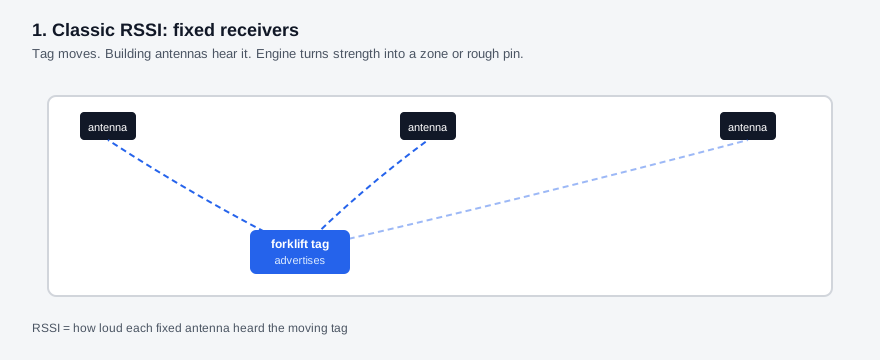
1. Classic RSSI with fixed receivers
Tags or beacons ride on the truck, cage, badge, or tote and advertise. Fixed antennas or locators on columns and ceilings hear those packets and score RSSI, the received signal strength. The location engine turns several strength samples into a zone or a rough coordinate on the hall map. This is the textbook BLE RTLS grid: infrastructure on the building, movers carry the cheap radio.
It scales when you already plan dense fixed hardware and want every tagged load to show without putting a tablet on that asset. It also inherits the usual 2.4 GHz friction: Wi-Fi congestion, body shadowing, and multipath that makes loudness jump without a clean meter scale. Sparse grids give bay search. Dense grids chase dwell and utilization numbers that only exist when coverage rebuilds full paths, the same spend lever covered under accuracy floors set by BLE versus UWB.
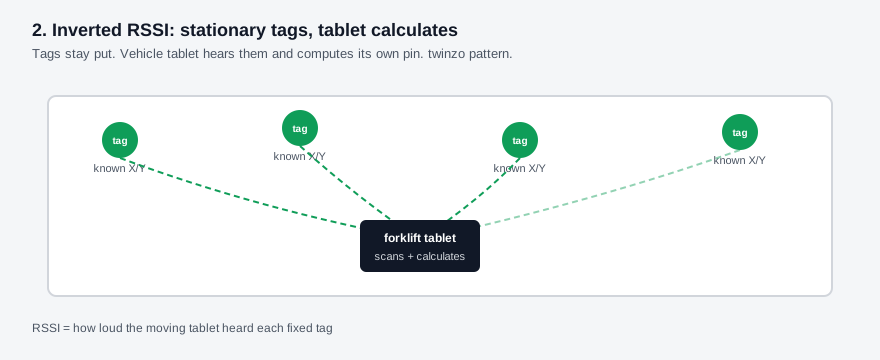
2. Inverted RSSI: stationary tags, tablet calculates
Flip the topology. Cheap tags stay fixed on columns, racks, or ceiling points as known anchors with surveyed X/Y. The forklift tablet (or phone) scans those static beacons, measures RSSI, and calculates its own position on the hall map. The vehicle becomes the locator. The building does not need a roof of dedicated RSSI gateways for every bay the truck visits.
That pattern is how twinzo keeps BLE deployments light on locator hardware and still feeds the same live twin used for internal logistics. Most competing stacks still hang locators on the building and put tags on every mover. The inverted layout is uncommon on industrial floors. It is one reason twinzo installations scale with tablets the plant already buys, then reuse the same pin for spaghetti, dwell, and empty-round work on the map.
The catch moves to the device. The tablet must actually deliver a stream of RSSI samples, not one lucky last dBm. OEM firmware that throttles BLE scan for battery looks like a coverage hole. Bench the scanner before you blame the beacon grid. That split is documented in Lenovo TB305XU limits iBeacon scan versus Teclast T50 Mini. Keeping a tag alive on every mover is the other cost trap when you stay on the classic topology. Put that labour into the payback sheet, covered in what to include when calculating RTLS ROI.
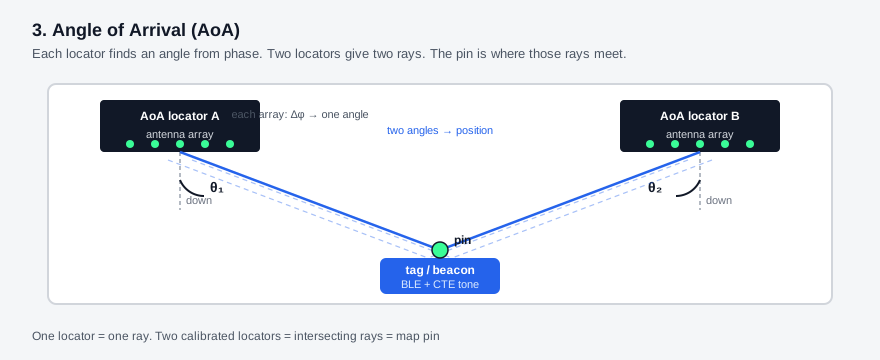
3. Angle of Arrival (AoA)
Bluetooth direction finding (5.1 and later) lets a multi-antenna locator measure the angle of the incoming packet, not only how loud it was. Angle of Arrival (AoA) samples phase across the array, often using a constant tone extension on the advertising packet. Combined with known locator pose (and often more than one angle), the engine places a tighter pin than plain RSSI trilateration in the same hall.
Plants look here when they want sub-meter (~3 ft) or near-sub-meter (~3 ft) BLE without jumping straight to a full UWB grid. Specialised arrays cost more than simple RSSI gateways. Calibration and honesty about line of sight still matter. Metal bounce creates ghost angles the same way it ruins strength. Prove a short aisle before you buy a full roof of arrays.
How the three compare in practice
1. What moves - Classic RSSI: tag moves, antennas stay. Inverted RSSI: tags stay, tablet moves and calculates. AoA: tag or phone moves, specialised array stays and measures angle.
2. What you buy densest - Classic: fixed receivers across the footprint you care about. Inverted: surveyed stationary tags plus capable forklift tablets. AoA: calibrated multi-antenna locators where the tighter pin is actually enforced.
3. Typical pin - Classic and inverted RSSI usually stay in the one-to-three-metre (3–10 ft) band for aisle or bay work. AoA can push toward sub-metre (~3 ft) when arrays and coverage hold. None of them replace UWB time of flight for every painted safety cell.
4. twinzo angle - The inverted RSSI layout is the uncommon industrial pattern that keeps locator spend on tablets the plant already runs, then lands the pin on the same digital twin used for logistics and production monitoring. Classic RSSI and AoA still ingest as modalities when the site already owns that hardware.
How teams pick among the three
1. Name the shift question - Bay search, continuous forklift path for empty-round cuts, or a tighter geofence. One question, one accuracy floor. Then pick the BLE method, or step up to UWB if the painted box is the decision.
2. Count what you refuse to mount - If the plant will not hang a receiver grid, inverted RSSI with stationary tags is the BLE path that still scales. If tablets cannot scan honestly, fix the device or fall back to fixed receivers. If you need angle geometry, budget AoA arrays and survey time.
3. Keep the pin on one map - Halls already mix BLE methods with RFID gates, RFID proximity, ceiling-antenna RFID RTLS that tracks a live X, Y, and Z, and selective UWB. The RFID split is in RFID for RTLS. twinzo’s job is the shared twin and the ops layer on top, from product capabilities to contact for a site walk. Definitions start at what is RTLS.
Pick the BLE topology for the decision you will enforce this quarter, not for a brochure accuracy number. Get in touch if you want to walk the same choice on your own facility model.